Thursday, July 28, 2016

"Ca Donne La Force"

You're warned before coming to Peace Corps Togo that much of West African culture places a big emphasis on drinking alcohol. Are you, the applicant, okay with this?

It's a tough line to walk. Drinking at the market with my neighbors has been an incredible key to integration - they appreciate that I'm excited about something so culturally important to them, and a drink sure helps my local language flow a little more fluently. After school meetings, it's expected that we share a drink, my director sometimes treating us to a real bottled beer (warm, of course - no electricity to power a fridge). However, setting a precedent like that can become a little less comfortable when I find myself encouraged to share a round during recess, before my last two classes, or to help wake us up in the morning before my family heads off to the fields for the day ("ça donne la force" - a drink gives you strength!). It's a balancing act, and a good lesson in big cultural gaps.

In the south of Togo, everyone drinks Sodabi, which is a moonshine made of distilled palm wine. But here in the north, it's tchakpalo (which is, unexpectedly, the French word. In Moba, we call it "dam.") Tchakpa is a beer brewed with millet or sorghum, a major crop here.

Tchakpa, though enjoyed by everone, is women's work. Most of the women in my village brew it, and I sometimes see older girls from my classes proudly selling their own tchakpa at the market.

Brewing is a process of several days. First, millet grains have to spend a day or so in a big clay jar of water in order to germinate. After that process has finished, the millet is piled into giant metal marmites which are then filled to the brim with water. A stalk from an okra plant is added to give a certain je-ne-sais-quoi (but really, je ne sais quoi), and the whole mixture is boiled for a few hours, until the water is more like millet juice. The liquid is scooped into big clay jars to cool overnight, and the sapped millet is drained, and then tossed to the pigs for a delicious breakfast.

The next day, the pre-tchakpa (which is drinkable already) is moved back to the marmites where it's boiled again, along with the yeasty remains of yesterday's brew (usually purchased from a neighbor) in order to get some good fermentation going on. The tchakpa is left to cool overnight and, voila, is ready to be presented to a sleepy Peace Corps volunteer in her pajamas at 7:00 am.

Slaving over the tchakpa stove

Because it's all done at home, and the fermentation process continues throughout the day, you can never be sure how strong the tchakpa you're drinking is. Sometimes one calabash (the dried gourd bowls it's drunk from) is just a pleasant way to pass the time, and other times, one calabash will knock me out for the rest of the night.  Some tchakpa mamas add hot pepper to their brew, which supposedly increases the potency of the alochol (and also, according to my village friends, gives you diarrhea).


Tchakpa is one of the most important - or at least ubiquitous - staples of Moba culture. It's everywhere. Sold in paillotes at the market, crowdsourced at funerals to get a good block party going, and offered to neighbors who come over to help with work, or just to talk, it's an inescapable part of every day life.

Fortunately, it's delcious.


My village market, where tchakpa is sold every Thursday and Sunday (and, really, most other days too)


Mama in her Sunday Market best, sitting on her stool, serving up calabashes of Tchakpa to neighbors.


Un Bon Repose

Summer Vacation is here, and for me that means a (much needed!) break from teaching. What am I doing? Smaller side projects, being a camp counselor, traveling a bit, and practicing the great Togolese art of the repose.

Weather is hot here, and work - mostly physical labor in the fields - is hard. This means that a big part of Togolese culture and daily life is resting. My Togolese family and friends return from farmwork each day around noon, and commence their repose. Usually this involves both lying around doing nothing, and sleeping.

The cement houses we live in absorb heat throughout the day, so the beat place to repose is outside in the shade, where you can catch a nice breeze. Just outside our compound, my host family has a "paillote," a small straw structure that provides a little shade, and is populated by a reclined bamboo chair and a few wooden benches. Thus is my host dad's preferred repose spot - lying back in his traditional chair, he conks out for an hour or two each day. By his side, my host mom will sometimes lie supine on the wooden bench, one hand brushing the ground, equally out of it for a while.

Other members of the family spread out in the compound, face down on the cement floor, or sprawled out on more wooden benches, making the whole household look like victims of a gas leak.

Three o'clock rolls around and we head out again, sometimes for more work or just socializing. And each night as the sun goes down, my host brother brings Dad's chair back into the compound, setting the battery powered radio beside it, to prepare for the evening's encore performance.


My little brother, lazing around in Dad's chair before he gets home to claim it.

Sunday, February 28, 2016

Three Fêtes

January 1, 2016

I woke up at 5 AM. Still dark, but in the distance, I could hear the shouts of a horde of small children. “BONNE ANNÉE,” they yelled, “BONNE ANNÉE!”

Bonne Année, what the French-speaking Togolese call New Year’s Day, is arguably the biggest celebration of the year. Especially because November and December are when many farmers are finally able to make money from selling what they’ve harvested, there is money to be spent on gifts, candy, booze, and parties.

I pulled myself out of bed and started brewing a necessary cup of coffee, wishing my host parents a Bonne Année as I moved around my compound. I could hear the children getting closer, and as I walked out of my kitchen, a group of six or seven kids ran into the compound.

“BONNE ANNÉE!” they said to me, and looked at me expectantly. Fortunately, I’d been prepared for this moment. “Bonne Fête,” I replied, and reached into a bag to give them each a few pieces of candy. They gleefully pocketed the mints, and scampered off to try their luck at the next compound. 

I spent the early morning with my host family, welcoming more groups of kids and drinking the Tchakpa that my host mom had spent the last three days preparing. At one point, my teacher friend Sonyenou rolled up on a borrowed moto and presented me with a guinea hen. I was flattered – gift giving is a part of any holiday here, but guinea hens are like chickens’ fancy older cousins. Eating and giving them here is often reserved for special occasions and important people.

I had been planning on cooking a chicken that I had been gifted a while back for my family on Bonne Année, but my host dad took me aside. “Yendoube,” he said, “when you get a new guinea hen, it’s really difficult to make sure that they recognize their new home and stay in the area. Chickens are easy, but guinea hens run away all the time.” He suggested that maybe, just to make it easier on everyone, I could cook the guinea hen instead. No problem! He and my 10 year old host brother took me outside, we grabbed the guinea hen, and papa went to town killing the poor guy for me. He tossed it to little bro, who plucked and butchered it, and before I knew what was happening, I had a bowl of guinea hen meat ready to be cooked. Throughout the day, we had people drop by to greet us and wish us Bonne Année, and we shared the meal I cooked with our guests, along with the seemingly endless supply of Tchakpa.

Late in the morning, my host dad took me on a little promenade to greet the chief and a few friends and neighbors. Each stop on the trip brought a drink, a small meal, or both – Bonne Année is all about eating and drinking. The quotidian meal here is typically made of corn or millet, along with sauce and occasionally meat, and tchakpa is what’s preferred to wash it down. But Bonne Année is different – it’s the one day a year when Togolese villagers indulge in pasta and beer. (And did we ever indulge!)

The afternoon took my host parents, a neighbor and I to the neighboring town of Sangkpong where we continued to greet the world with Bonne Année wishes. In Sangkpong, we sat at a bar (a first for me and my family!) powered by solar plaques, and enjoyed a rare (for me, rarer for them) cold beer. My host father expounded on the merits of mixing tonic water into the beer, and he wound up ordering a tonic to mix up the concoction. (Spoilers: it’s not very good.)

We returned to the compound as the sun was going down, to have one more quick meal of macaroni. Full, exhausted, we all headed off to bed, shaking our heads at my younger brothers and sisters heading out to the market to keep celebrating.


January 8 2016
“Today I’m very happy,” said my counterpart, Kolani, as he walked into the class we co-teach. “Ask me why I am happy.”

“Why are you happy?” the students chorused.

“Because today is my birthday!” He tossed a big bag of candy to the major – the class president – to hand out to everyone. The class cheered, and we continued the lesson.

At the end of the school day, the six teachers crowded around the office door as we locked up for the afternoon.

“Alright,” said my friend, Sonyenou, “let’s go.”

“Go where?” Were there plans I had forgotten about, or misunderstood?

“Over there.” He pointed to a compound situated a few hundred yards from the school.

A strategy I’ve adopted during service – important, when I’m only ever 75% sure I know what’s going on – is to let go and just say yes. So I followed Sonyenou and my other teacher friends to what turned out to be Kolani’s birthday celebration.

We greeted the head of the household as we walked into the little clearing with chairs and stools waiting for us. After a moment, another man from the household came and sat down with us. He came bearing a big metal bowl, 3 feet across, covered in a cloth and buzzing with flies.

Something about this didn’t seem to bode well for the last vestiges of my vegetarianism.

Our new friend with the metal bowl pulled back the cloth to reveal a pile of aging brown meat. Where did it come from? How long had it been in that bowl? Was there anything sanitary at all about this situation? These questions did not cross my teacher friends’ minds, and they leapt up, drooling, to take a closer look.

As I struggled to control waves of nausea, they pawed through the different unidentifiable cuts of meat and ordered what looked most delicious – 100 CFA worth of that brown lumpy stuff, 50 CFA worth of that long chewy-looking thing, and so forth. When finally they’d filled a small metal serving bowl, our host topped it off with Maggi powder (more or less just MSG), and they began to dig in.

“Yendoubé,” they said to me, “It’s Kolani’s birthday. You have to eat.” So eat I did.


February 5, 2016

The time between November and March is “funeral season” here in Togo. Funerals are big, important celebrations for which whole villages turn up, and these dry season months after the harvest are when work is scarce and money is rolling in from crop sales, so deaths from throughout the year are fêted now. Typically, funerals are two day affairs. The ceremony and – sometimes – the actual internment are spread across these days, interspersed with dancing, eating, drinking, and gift giving.

This week, my host mom invited me to go with her to a funeral in Bombuaka – a neighboring village where she grew up. The deceased was a member of her extended family, so she was very excited to bring me to meet her parents and see “chez elle.”

Friday afternoon rolled around, and she and I hopped on our bicycles to head out to the event.
Stop number one was her brother’s house. “Brother” is kind of a loosely applied word here – because men have multiple wives, you and your brother probably do not have the same mother, and cousins and uncles are often referred to as brothers, too. The brother in question was, I believe, a half-brother of my host mom’s father, but in any case, it was important to stop and greet.

The culture of greeting is incredibly important here – before getting down to any business, you must first ask after someone’s health, family, and work. It’s important to even quickly greet anyone you pass along the street, and stopping by a friend’s house to greet them is an important way to maintain your relationship.

Anyway, we sat down with my host mom’s grand frère, and said hello as his wife trotted out a few calabashes of tchakpa for us – my first of many.

After a few minutes of chatting, we hopped back on our bikes and continued on to the house where my host mother grew up – her father’s house. We were greeted by him, his second wife, and a horde of children who may or may not have been related. It was really a blast to meet him and see the family resemblance, and my host mother was excited for me to break out my camera and snap a few family pics.

Finally, it was time to continue on to the funeral itself. As we got nearer to the hub of the celebration, we encountered more and more people, including many friends of mine who had come over from Nassiete.

Another calabash of tchakpa was pushed into my hands as we greeted, and mama and I sat down on a mat on the floor of the compound. It was time to eat. We were served a small mound of pate each, and had two different peanut sauces to dip into.

After the meal, we got up and followed the sound of music. Moba music is a handful of drummers and some small, almost atonal flutes that sound like birds. Musicians stand in the center of a circle, and funeral-goers dance around them. The “Moba shake,” which is the traditional dance in the north, involves some rapid hip shaking while slowly making your way around this circle. Some dancers will hold tree branches in their hands, or wear belts made of small shells. We joined the dancing circle for a few minutes before night started to fall, and we needed to take off.

Monday, December 28, 2015

Projects, Projects

I think I often start these posts with disbelieving comments about how much time has passed, but seriously, wow: last week, I celebrated my six month anniversary of being in country. Holy Cow!

The first trimester at school wrapped up last week, and the upcoming week the students have “compositions,” or final exams. I’ve got a little bit of proctoring to do before my two week Congé du Noel! School has been mostly uneventful – lesson planning, teaching twelve hours each week, struggling to keep control of classes overflowing with students, and little moments of success when kids sensibly string a sentence together. Go, kids!

A few weeks ago, fellow PCV Sarah (who is also a teacher in the neighboring village of Bombuaka) came and sat in on a few of my classes. She did me a favor and snapped a few pictures – enjoy!

Reviewing for the Test


Kids Getting Into the Spelling Competition


Now that we’re passed the initial three months at site – which Peace Corps encourages us to take as time for integration and initial project planning – it’s also been time to start doing other projects.
Second-year Savanes volunteers Matt and Travis have been working with the S.O.S. Orphanage in the regional capital of Dapaong, and invited new volunteers to help with some information session projects they were doing there. For three weekends in a row, the plan was to hold “sensibilisations” (a French word for which I do not know the exact English translation) for women’s and agriculture groups associated with the orphanage.

Each weekend, an army of us – 13 volunteers in total! – descended on S.O.S. to do these trainings – one on nutrition, one on seed propagation and compost, and one on double digging (yeah I don’t know what is either).

Some of us did actual presentations, others distributed pre- and post- tests for Monitoring and Evaluation purposes (very important), and the rest were on “keep all these goddamn kids out of the learning area!” duty. All fun and interesting – I was mostly responsible for the latter two tasks.
Check out some great photos of this work, courtesy of photographer and beard-grower extrordanaire, Aaron Sepulveda:


Distributing Pre-Tests


Health Volunteer Travis Introducing the Session


Agriculture Volunteer Michael Supervising the Double Digging


I also teamed up with Health sector volunteers Jenny and Ashiana (and my teacher neighbor, Sarah!) to host an afternoon of sex-ed with the girls at my school. In the school system, there is a curriculum of sex-ed, called “ESEPSI,” (Education Sexuelle et la Prevention de SIDA et IST), but it is taught by my aging male school director (not an ideal role model for young girls, especially on a sensitive topic riddled with stigma for women). Also, with the high rates of early pregnancy that cause girls to drop out of school, we believe that it’s important to address the issues of choice, and sex as a partnership and conversation, to work towards empowering girls to make healthy decisions for their futures.

So, armed with these themes, anatomical illustrations, and a few empowering Beyonce quotes (translated into French, of course), we spent the afternoon encouraging conversation about gender roles, contraception, and the nitty-gritty of the vagina.

We also gave them candy, which turned into a terrifying stampede.


Here’s some photos, courtesy of Jenny, and our official media volunteers for the event, Morgan and Blair:


Ashiana and I Talking about Gender Roles


Jenny, Sarah, 150 Togolese Teenagers, Me, and Ashiana


Morgan, Sarah, Me, Ashiana, Jenny, and Blair After the Event
(Plus Bonus Nacho the Dog and Student Photobomber)

Saturday, October 24, 2015

Me and Julio Down by the Schoolyard

I’ve now been at site for two full months, and teaching for a full four weeks. And what an experience the Togolese classroom is! I feel a little lucky that I’m doing this having never taught before… I can’t imagine being an experienced teacher and having to adjust to the crazy differences in education between the two countries.

My School - CEG Nassiete


Every morning, I wake up at 5:00, giving me enough time to eat breakfast, get ready, and make the 15 minute walk to school by 6:45. At that time, the “major generale” (the head student of the school) blows his whistle, calling for each class to line up on the front lawn. We stand quietly and watch as the Togolese flag is raised up on the big branch we use as a flagpole, and then the major calls on one of the classes to sing the national anthem. Then the whistle is blown again, students scatter back to finish sweeping the classroom floors, and teachers do last minute prep in the office before first period starts at 7:00.


The school is a big cement building with five rooms – four classrooms and the office. Each room is big and airy, with a big grid of window holes built into the walls. Wooden desks fill the room, and each seats between one and three students, depending on the size of the class. (My largest class, 108 students, has kids packed like sardines three to a desk, with barely enough space for a skinny Togolese tween to navigate between the rows. Me walking to the back of the classroom is out of the question!)  There are two large blackboards, one at the front and one at the back of the classroom.


The school day goes until noon. Each grade has five classes, 55 minutes each, with a 25 minute break in the middle of the day. Each classroom houses one grade, and students stay in their rooms for all of their classes – it’s the teachers who switch around. At break time, two or three women show up near the school to sell snacks – beignets, porridge, and plates of rice with hot sauce.

I teach three grades – the sixieme (the youngest kids, just out of primary school), cinquieme, and I co-teach the quatrieme with Monsieur Kolani, the other English teacher at my school. I’ve already shocked you all with the size of my sixieme class (I repeat – 108 kids!), but the other two classes are more manageable, with between 40 and 50 students in each.

Not Actually Teaching, Just a Photoshoot


We’re expected to do three activities in each class – usually a vocabulary lesson, a grammar lesson, and some kind of reading or listening activity. Reading exercises are tough, because resources are tough to come by. The school only has about 13 books for each class – and those are ragged photocopies that my homologue painstakingly reglues at least once a week – and even in my smaller classes, three students need to crowd around each copy. Other exercises are tough, too, because of the number of students – Even if I could call on everyone each class, it wouldn’t be nearly enough talking for them to improve their English. Groupwork is a totally foreign concept in the rote-memorization environment of Togolese school, but I’m trying to introduce it little by little.

Though I’m not a Togolese student, I imagine the biggest obstacle is having school entirely in French. It’s nobody’s first language – children speak only Moba until they start learning French in primary school, and though that’s earlier than most American s start a foreign language, it’s still wild to me that by age 12, they’re required to attend a school where all subjects are taught in the second language they’re learning. I couldn’t do that. It’s totally impressive, and also no surprise to me if kids struggle!

There are five other teachers at my school – all men – and our director. Other, larger schools have other authority figures (like a senseur, or chief disciplinarian), but because we’re so tiny, a lot of those kinds of duties fall on the teachers and director. So far, everyone has been very welcoming, and are very lenient with the amount of non-teaching responsibilities I’m ready to take on at the school!

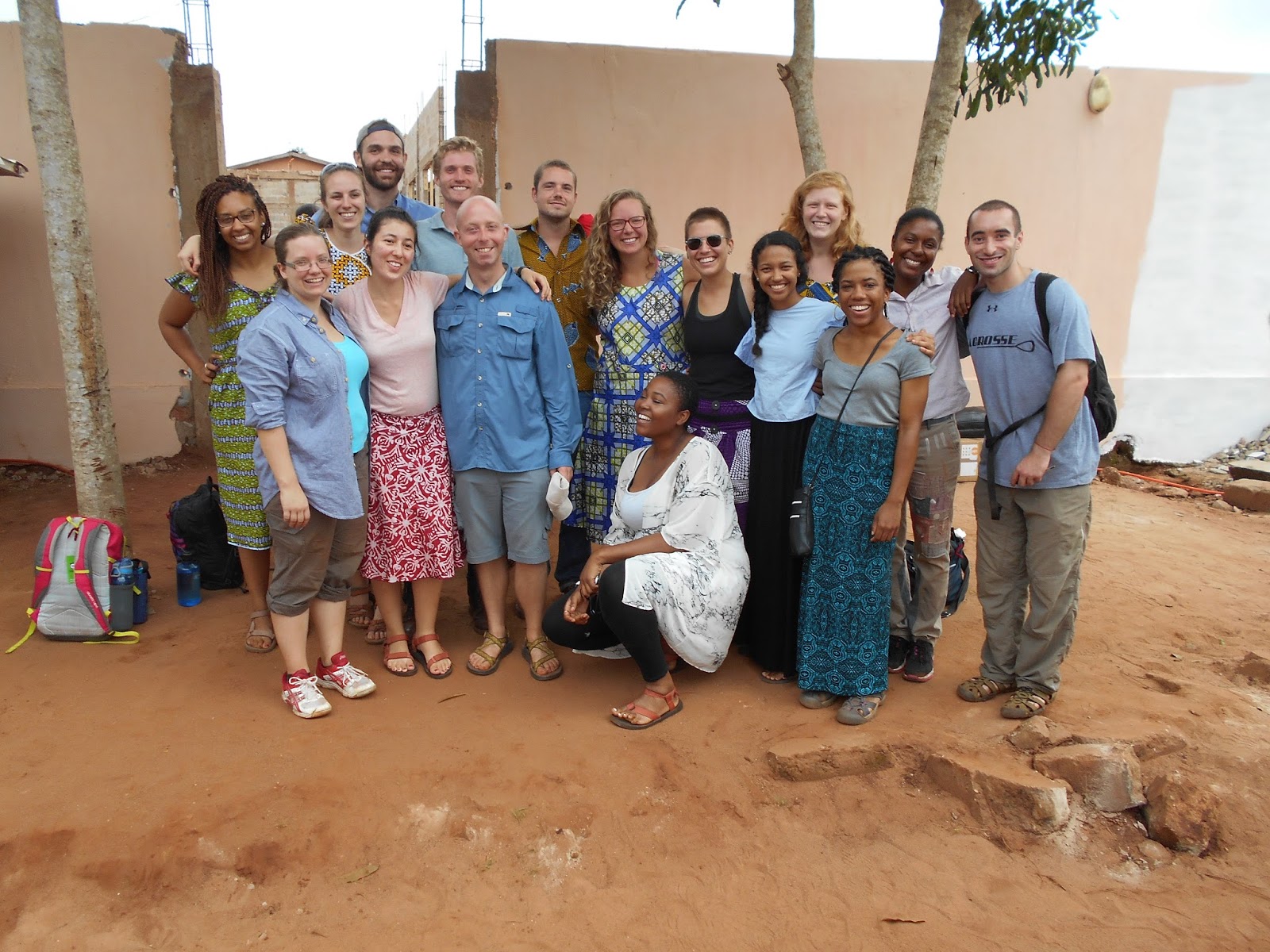
Fellow Volunteer Morgan, Me, Kolani, and Soyenou

Kolani, the other English teacher at the school, is my Peace Corps appointed counterpart. We’re all supposed to search out many homologues to collaborate with, but he is my springboard. He’s incredibly nice, and excited about being able to converse with someone whose native language is English. We’re hoping to start an English club at the school, and maybe a local English Teachers’ Club, for teachers in neighboring villages to get together and talk in and about l’Anglais.

My other best friend at school is named Soyenou. He teaches French and History/Geography, and has volunteered to help teach me Moba, the local language. Twice a week, we meet at the school in the afternoon, where we spend an hour learning new vocabulary words, and practicing sentences I can use at the marche. “N bwa n da dam piile,” I find myself saying often, “I want to buy 100 francs worth of Tchakpalo.”


Learning local language is a great key to integration. Nothing seems to make my neighbors happier than being able to greet me in their mother tongue. I’m not sure whether its sincere appreciation of the effort I’m making to be a part of the community, or glee at the ridiculousness of some white girl mispronouncing phrases they’ve known from childhood, but either way, I’m happy to put a smile on someone’s face when I can answer “A saa le?” – “Where are you going?” with a broken but confident “N saan kalatu je,” “I’m going to school, but I’m coming back!”

Saturday, October 3, 2015

Savamily Goes to the Caves

A few weeks ago, the volunteers in the Savanes took a field trip to a village called Nagou. It's my friend Michael's site, but also, boasts the only UNESCO World Heritage Site in Togo. Several hundred years ago, the Moba people built a series of caves on the top of a mountain, which they retreated to during war. The caves are perfectly situated to defend, and our tour guide (a man from Michael's village) pointed out rooms where women would cook, where poison arrows were hidden out of the reach of children, and hidden gullies into which warriors would lure enemy cavalry.

We woke up early to hike Michael's mountain, and spent the afternoon exploring the caves, drinking tchakpalo in the Nagou market, and dancing with the village.

Check out some pics!

Setting Out for our Climb

Made it to the Top!

Looking Out Over the Savanes

Cliffs By the Caves

Molly Descending into the Caves

Exploring

Caves

Ashiana and TJ at the Caves


Moba Dance Party

Friday, October 2, 2015

Je Suis Voluntaire!

Greetings, one and all, from an official Peace Corps Volunteer! I’ve said my oath, I’ve signed the paperwork, I’ve been to the afterparties, and can now say, without any asterisks, that I’m a PCV.
Tuesday the 25th was our last day at our training center in Zafi. We had our final “Readiness to Serve” interviews, to make sure we were committed to the tenets and qualified for the rigors of service. Following the interviews (and our cheers as we bid farewell to the training center for the last time), the 45 of us piled in the vans to go to the neighboring town of Ahepe for the farewell fete with our host families.

My Kouve family can be a little – hmm – enthusiastic when it comes to Americans, fetes, or fetes with Americans. The weekend before, they encouraged me to invite some friends over for lunch and what they were calling a “journee Americaine” – an American day. I was told we would eat real African food for lunch, but would listen to American music. I thought that sounded great, and a few friends came by around noon. We should have something was up when our lunch was two hours late and my host dad was setting up a microphone system in our little compound (where do you even find a microphone in Togo?), but before we even had time to be worried, my family was parading the nearest three dozen children in front of us, urging them to sing the Togolese national anthem and any church song they could think of into the mic. We clapped uncomfortably as we dug into the peanut sauce that was finally ready, but we were barely halfway finished eating before my uncle let us know that it was now our turn to share an American dance, so stand up! We tried to explain to them that we weren’t going to do that, we didn’t know any American dances, they really just aren’t any American dances, but the excited eyes of the whole neighborhood were not going to let us off the hook. My friend Zoe gamely came to the rescue, demonstrating something that was basically a dance (there was a little bit of twirling, anyway) to the tune of “Build Me Up, Buttercup” that she had performed in the fourth grade. My family was momentarily wowed, and before they could recover to demand an encore, my friends used a distant grey cloud as an excuse to run home as fast as possible, “avant le plu.”

Anyway, with that afternoon still fresh in my mind, I was a little nervous about the big farewell party. As much as I love my family, and know that they are just crazy about cross-cultural exchange, I was not excited to do a lot of performing. Fortunately, it turned out to be all fun and no pressure – a great sendoff.

All of the Kouve families got together and selected a pattern of pagne (the brightly colored and wildly patterend fabric that West Africans wear). They bought out all local stock, and commissioned shirts and dresses for all 16 volunteers and their hosts, so walking into the fete, Kouve was a sea of white and blue geese.


Me and the Kouve Fam


 We took twenty minutes or so to hug and take photos all together, and then sat down to a potluck dinner. There were speeches of appreciation from Peace Corps staff and host families, and two volunteers got up to give speeches of “merci” and “akbelo.” The crowd, as usual, went nuts for the American speaking in Ewe, the local language. A dance troupe came in and performed, and invited everyone to come join them. This eventually devolved into just general dancing, and before we knew it, it was time to pile into the vans again and leave.

This was also my first real taste of traveling with Togolese. I’d been told that travel was a frantic and crowded affair in this country, but was not expecting it to be so in this venue – in vans run by the Peace Corps, traveling a scant 4 miles.  As soon as it was announced that the vans were ready to depart, everyone in the room booked it for the door. I was in the middle of saying goodnight to my American friends when my host family pulled me into the stampede with them. “Let’s go!” they said, “The vans are going to leave!” seeming to imply the possibility that we might get stranded in Ahepe forever.

We were among the first out the door, and immediately, the whole throng poured into the first available van. Surprised, and not wanting to be trampled, I stood off to the side. The vans have room for 14 passengers (which in Togo means 20), but within ten seconds, there were two dozen people crammed in. My host uncle, who was sitting in the back corner of the van, was shrieking my name and frantically reaching across his neighbors laps, hoping to (I guess?) grab me and pull me in, as though they were in the last lifeboat leaving the Titanic.

The driver let me know there was no one yet in the front, so I hopped in. Zoe managed to grab the other front seat, and we were able to pass the 20 minute journey pretty comfortably, especially compared to our 6’4” friend Nate who sat behind us, sandwiched in a row with five Togolese passengers.

The next morning, we said goodbye to our families and hit the road to return to Lome. We unloaded at our beloved Amy’s hotel which, though ominously one-star when we first arrived in Togo, was now some kind of Shangri-La, with its running water and its weird mini pizzas.

The next two days were a bit of a blur – last minute security sessions and paperwork, setting up bank accounts, buying mattresses, and visiting the legendary “yovo stores:” big super-marches with Nutella and real plastic brooms. The nights, too, were a blur, cramming in as much time with good friends before heading off to new homes, hours apart from each other.

Friday morning rolled around – swear-in day! Each of the three sectors selected a pagne pattern to wear for the day, so we left Amy’s for the US Embassy looking fresh and sufficiently matchy.
(No phones or cameras were allowed in the embassy, so please accept this low-quality selfie to get a sense of how beautiful we all looked.)

On y va, Faire la Selfie


Check out these articles on the swear-in ceremony! Warning: have a francophone or Google translate handy.


The rest of the day was spent celebrating, and the following morning, bright and early, we packed ourselves into assigned vans and hit the road for our permanent sites.

On The Road


The Village of Baga

Tuesday, August 25, 2015

The Home Stretch

It’s happening!

Stage is essentially over for us. We’ve wrapped up our technical training, taken our final language placement tests, sat through our “readiness to serve” interviews. We go to the US embassy and officially swear in as volunteers on August 28th.

Some Last Looks at Kouve

These last few weeks of training focus on technical skills, so education volunteers have been spending our days at the local college. In the Togolese school system, kids start with kindergarten and primary school, and then move to college, which is roughly equivalent to 7th through 10th grade. Once they move past college, they spend two years in lycee. If they are on track, age-wise, and complete all grades, children are in school until they are about 20, but many start late, get left back, or drop out early for work or marriage.

The sixteen of us split into groups of two, and each pair was assigned a class to teach for a two-week “vacation school.” We’d each take an hour with the class in the morning, and would spend our afternoons debriefing (a favorite Peace Corps word) our lessons, and learning new strategies and realities for teaching in general, and in Togo specifically.

My buddy Andrew and I were assigned a Quatrieme class. Quatrieme is the third year in college, and the oldest class volunteers are allowed to teach. It’s also arguably the most difficult, and many volunteers opt not to teach it (though my school is so small I’ll have to, in order to hit my minimum classroom hours). Quatrieme is when kids start to learn more complicated grammatical structures – tricky, for a fluent English speaker/untrained English teacher such as a myself. More challenging, though, is that in the Togolese system, students can pass a year of college without passing all of their classes. Some Quatrieme students will be rockstars in English, and others will have used their other grades to balance out terrible their English ones. In Quatrieme, even more so than in the younger grades, you have to teach to a huge range of skill levels. And did I mention that each class usually has 50 or 100 kids?

Anyway, Andrew’s and my vacation class Quatrieme was none of that. Because the school was an optional event in the community, Peace Corps took what we could get in terms of sign-ups, so we taught an average of 11 kids each day, many of whom were almost done with lycee, and were just in class for review, or for something to do, or to hang out with some Americans. They were great kids, who breezed through the review lessons we gave them. It was definitely a good experience to be in the classroom, but I think I’ll still feel a little unprepared when the school year starts, and I have to stand up in front of 75 kids who don’t speak a lick of English.

My host family is starting to get very sad that I’ll be leaving soon, so they’ve been cramming in a lot of family activities and Togolese food. Last weekend, my host dad, uncle, and cousin took me to the fields to show me how palm wine is harvested. I’m sorry to tell you that I forgot my camera for this excursion! First, big palm trees are felled, and a shallow four-inch square is carved into the top of the trunk. Only a tiny whole extends all the way through the trunk. Palm farmers use a giant stick of fire to clean and sterilize this hole – a process the repeat regularly during the tree’s 30 days of wine harvest. They stick a jar or plastic jug underneath the tiny whole in the trunk, cover the square with a leaf to protect it from bees, and let the palm wine drip from the whole tree into the square and through the hole. It comes out as sweet as candy, and is ready to drink directly from the source.

We also took a trip to a neighbor’s house, where they have a still to turn palm wine into the local moonshine called “sodabi.” Sodabi is incredibly popular here, and a great business to be in. Many drink sodabi after a long day in the fields, but it’s also used in many ceremonies, and is often toasted with before eating a meal of fufu (but never before rice, I’m told, or you’ll get very sick). Because it comes from palm wine, it has a sweet taste. I think it tastes a bit like tequila, but friends of mine swear it’s just like Sake. Either way, because it’s home-brewed, it’s sometimes about 80-proof, and sometimes it’s straight rubbing alcohol.

Moonshine a la Togo


We’ve also been eating more Togolese food, instead of Togolese renditions of what Americans eat. I’ve been eating a lot of pate (pronounced like “pot”), which is basically like polenta or grits, but without any ingredients other than corn. Togolese eat pate alongside a variety of sauces – peanut sauce, tomato sauce, okra sauce. My favorite meal, which is called something like “Djankuman,” is pate cooked directly in a spicy, oniony tomato sauce. My host sister has promised to teach me how to cook it before I leave for site.

The Whole Family


It’s definitely a bittersweet time. I’m really heartbroken to leave my host family, and to be so far away from close friends I’ve made over the last few months, but am very excited to be settled in to my permanent site.

Saturday, July 25, 2015

Headin' Up Country

The past two weeks have been nuts – brace yourselves for an action-packed entry!

Two weeks ago was Site Placement Day. As volunteers, we have no input into our placement, other than our language abilities and our resume. Even though Togo is a small country, there are huge variations between areas in both nature and living conditions. Needless to say, placement day was pretty nerve-wracking.

While we spent the morning in language testing (I moved up to Intermediate-Mid, by the way), the training team drew a giant map of Togo in the sand, and stuck wooden posts into the ground to approximate the locations of all 47 sites. Our training host families poured into the compound, and when the hour finally arrive, we gathered around the map and waited for Jane, the programming director, to read out our fates.

I was among the first names called – along with ten other new volunteers, I would be heading to the Savanes region in the far, far north of the country, to a village called Nassiete. The “site summary” I was given had little information about the town – 15 km from Dapaong, the regional capital, a beautiful view of a mountain, no electricity. I’d have to wait to find out.

The week passed by in a whirlwind, our time filled with sessions scrambling to prepare us for our two-week visit to site. We learned how to ride on the back of a moto, we met our counterparts (who were in town for their own workshop), and we went to the big market in Tabligbo to buy last minute supplies.

Incoming EGE Volunteers!


Saturday morning arrived in no time. The Peace Corps van picked me up from my compound at 5:30, and drove me to meet the rest of the volunteers and counterparts in the neighboring town of Aheppe. We all said our goodbyes, and piled into our assigned vans. The three vans going to the Savannes would reconvene in the town of Kante, in the Kara region, to spend the night in hotel – the journey north is not a one-day affair!

Travel in Togo has a reputation for being dirty, unpredictable, and generally the worst. We kept ourselves cool by opening the windows, but that meant I was coated in a solid quarter-inch of kicked up dirt a half-hour into the journey.

As we barreled through the Centrale region, we heard a worrisome noise from the undercarriage. We pulled over, only to discover a shot transmission. Welcome to Togo.

We volunteers walked with our counterparts about 10 minutes to a neighboring village, where a family was kind enough to lend us some shade. In exchanged, we terrified their young son with our glaringly pale skin. We waited for about 45 minutes while the other Savanes vans, a little further ahead, pulled some switcheroos, and an (air conditioned!) van turned around to retrieve us and our luggage.

Switching Luggage Around


All Crammed In

The rest of the journey, we crammed three vans worth of people into two, but the company (and the climate control) was pleasant. We rolled into Kante just after the sun went down, and spent the evening chatting with a few volunteers who came up from their villages to greet us. I even topped the night off with a running-water shower.

The next morning, everyone woke up with nerves: we piled back into the vans to finish the journey to our new homes.

Nassiete is only a few kilometers off of the main route, but there’s a world of difference in that small space. We said goodbye to the paved national route and electrical wires, and were greeted by giant, lush fields and towering flat-topped mountains. You can’t take a car to get to my compound, so I was dropped with all of my baggage on the side of the road. All of the village chiefs were there to welcome me, along with the school director, and a handful of other folks.

As is the way here in the north, we celebrated my arrival right then and there with a quick chicken-slaughtering welcome ceremony – a weird mélange of honor and horror for me. (To do: get over American sensibilities about animals, and quick.) Once the poor bird flapped its last flap, we set off on a 10 minute walk through the fields to arrive at my compound.

View From Outside the Compound

I’m living on the Bouna family compound. My host father is the president of the APE – the Association de les Parents des Eleves. He has two wives (polygamy is quite common here), and there are a total of six kids in the family, none younger than eight or so. Also on the compound are chickens, pigs, goats, cows, a donkey, ducks, a million pigeons, two dogs, and a cat. It smells a little barnyardy. I have two rooms of my own, each with cement walls, a tin roof, and a little barred window. I also have a latrine and walled-in bucket-shower zone to call my own. The water pump is about a five minute walk from the compound, but after an embarrassing display of my water-carrying ability, my host family has taken over that task for me. I’ve got some learning to do, I guess.

My Building!

Nassiete is quite large, area-wise, but only about 800 people live in the village – there’s just a lot of space for farms. There’s a primary school, and a “college” (for kids approximately 13 – 17), but for the next level, called lycee, students need to travel to the next town. We have a little boutique which is sometimes open where I can buy cookies and soap. And we have two twice-weekly “markets,” which, in actuality, sell very little, and are more just pop-up bars for the local brew, made of fermented millet and called “Tchakpalo.” And that’s the extent of that. If I want to buy phone credit or a vegetable, I need to hitch a moto ride to a neighboring village.

My Mountain


And everyone is so, so wonderful. People are friendly, helpful, welcoming, and patient with my French. They try and teach me phrases in Moba, the local language, and laugh with what I hope is glee when I can stumble through a greeting.


I’ve even been given a Moba name: Yendoube, which means "God is There." I've got a lot to live up to.

Sunday, July 12, 2015

Ca Va? Ca Va.


Stage is almost halfway over?! Where does the time go?

Monday is a big day, because it’s the day of site announcements – each of us will learn where in the country we’ll be spending the next two years. The five regions of Togo (Maritime, Plateaux, Centrale, Kara, and Savannes) each have their advantages and their disadvantages, but we’ll finally have a little bit of an idea about what we should be nervous about.

We’ll spend the rest of the week meeting our homologues (each of us will have an identified professional counterpart in our village, who we can rely on to help us with introductions, work, etc.), opening bank accounts, and otherwise getting ready for Saturday, when we’ll leave for a two week visit to our permanent sites. Am I ready? Nope! Is it happening anyway? You better believe it.

This Monday, we also take our mid-training French exams. If we’ve reached an “Intermediate-High” level, we get to switch to exclusively learning the local language of our site, after we return to Kouve from our visit. I started at “Intermediate-Low,” so we’ll see…

I have to remind myself to not worry too much about the stuff coming up, and to focus on what’s happening now!

This week was “French Immersion Week” - we spent the whole week in class, or doing activities and presentations enFrancais. Tuesday, we presented in a Talent Show. Thursday, we practiced presenting ourselves and our work to our communities (as performed by our formatuers, who hilariously hit us all with questions we’re likely to get – “Are you married? You should marry my nephew.” “The electricity doesn’t work at the hospital, can you fix it?” “Can you get Barak Obama to come visit?”). We took a field trip to the neighboring town of Aheppe, where we visited the bus station and the post office. And yesterday, we took our “Core Competency Exam,” where we sat with five different formatuers in turn, each testing our ability to navigate different cultural situations (the market, asking directions, etc.) in French.

We also had an “Iron Chef”


competition this week – in groups, we visited the market to pick up a list of ingredients, and had two hours to cook two different meals on little West African wood stoves.


Blair, Morgan, and Becky standing over our stove

With our showing of Peanut Sauce over rice, and beans with gboma (a vegetable kind of like collard greens), our group took a solid sixth place out of eight, but each group won a sleeve of Oreos regardless.


And day-to-day life is good – it feels like a routine here, now. On my bike ride to class, I’m greeted by absolutely everyone – some call me Diana or Abla (which is my Ewe name), many more call me Yovo (which basically means “white person”), and a few call me “Zoe” or “Natalie,” the names of other volunteers. My language class and I walk to our favorite boutique during our mid-morning repose each day to buy cookies, toilet paper, and phone credit, andUtsa tells us we’re stealing his time when we’re five minutes late, as we always are. Every Friday, the Kouve volunteers get together at our favorite bar, “Le Courage,” for a much-needed hour of beer and English.

Since last entry, I’ve taken a few more photos of my compound – check ‘em out!


My bed, complete with mosquito net


This is the house I live in... my room is on the right

Sunday, June 28, 2015

Greetings from Kouve!

I can’t believe I’ve only been here for two weeks… it feels like I’ve never not been here!

I’m writing from the Cyber Café in the village of Kouve, where the Education volunteers are making their home during pre-service training. Kouve is a pretty sizable town (compared to neighboring Zafi, anyway) – my host family tells me several thousand people live here. There are boutiques, bars, and a big market every Thursday.


My home here is  in the district of Kouve called Boli, which is pretty quiet, as far as this town gows. There’s a cement wall with big red doors surrounding my compound. Inside the walls, the ground is covered in Africa’s famous red dirt, and a dozen trees bearing bananas and limes are scattered throughout. There’s a large well from which I draw my big bucket of water every day, and a shower stall where I take my twice-daily bucket baths. We have one large-ish house where my family relaxes and cooks, and another, smaller building where I live.


My building has two rooms. On the left, my host aunt Abla sleeps with her three children (including adorable 2-month-old baby Joseph). My room is next door. It’s a little smaller than the bedroom I had growing up, and has cement floors and bright blue walls. Bedsheets line the ceiling to help keep out bugs and lizards. (These second-hand bedsheets are themed with cats and Harry Potter – how did they know me so well before I even arrived?) I sleep in my Peace Corps issued twin bed, and make sure to tuck in my mosquito net every night. I have a small desk, a little table to store my coffee mug and other food accouterments, and a corner dedicated to my many useful buckets.

Each morning, the sun comes up around 5, and I’m gently woken up by the sounds of sweeping. The red dirt gets everywhere, so a daily pass through the compound with a palm-leaf broom is a necessity. I get out of bed, sweep my own floor, and take a quick shower before eating breakfast al fresco with my sister (cousin? aunt? It all blends together for me here) Odette. Sometimes, we have bread with peanut butter or eggs, but occasionally, she makes beignets (and these Togolese doughnuts are the best I’ve ever eaten).

After breakfast, I hop on my bicycle (Dad – it’s a red Trek 4100!) and pedal to school. Some days, we have French lessons all day. These days, I go to my classmate Danielle’s house, where I spend the day with her, our one other classmate, Zach, and our instructor, Utsa. We do some work in a textbook, but mostly, Utsa just tries to get us talking as much as possible (and, of course, it’s all French all day). I’m nowhere near proficient, but I can feel my French getting better every day.

Other days, we have big group learning sessions. All of the volunteers in Kouve pile into the white Peace Corps van and drive the bumpy road to Zafi, where we join the food security and health volunteers. We spend the day with the Togolese Peace Corps staff in sessions with names like “Roles of the Volunteer in Development” and “Dealing with Unwanted Attention.”

Wherever I am for the day, my family sends me along with a packed lunch. Peace Corps advised our families to ease us in to Togolese food, so I’m still eating a lot of spaghetti and hard-boiled eggs, but I occasionally have pounded corn (called pate) with a sauce made of tomatoes and fish.

After school, I rush home to beat the sunset, which happens promptly at 6:30 every day. I have dinner with Odette, and we are sometimes joined by my host father, Aristide (who is my age), and his brother, Justlan. I could not have asked for a more wonderful host family. Everyone that I interact with (mostly these three people) speaks great French, and are so incredibly patient with my terrible rendition of the language. They are warm, funny, and respectful, and just such a blast to be around. Each night, we spend hours sitting outside and chatting, and it’s often the best part of my day.

All in all, life is good here in Kouve. With so many unkowns ahead (I don't find out where my permanent site is for another few weeks), it's nice to have a routine, and to be surrounded by such great people.

Sunday, June 14, 2015

Two Days in Togo

I have to admit, I’m typing this after polishing off my first Togolese beer, which is closer to 40 oz. than it is to 16. This evening, a PCV stationed in Lome came to our hotel to welcome us and was generous enough to bring a 12-pack with him. But let me back up.

Wednesday morning, all 49 of us checked out of our hotel, and boarded a couple of coach buses bound for New York – a really fun opportunity to get a last look at New Jersey, the motherland. (The turnpike is a great last view of the USA, right?). After a few hours on the road, we arrived at JFK only to discover we had to wait until 4 hours before our flight to check in. Cripes.


We lolled around inside this sea of suitcases until it was time to check in. Finally, after a full six hours in JFK, we boarded our plane to Brussels.

If you’ve ever wondered about the moment when the full effect of what I was doing hit me, this was it. Taking off in New York was when it really set in.

Of course, we still had to deal with more than a full day of travel before it actually was real. Brussels Airlines was comfortable, but six and a half hours on a plane was not. Neither was the nine hour layover in Belgium. My brother Daniel promised me the best chocolate of my life in that airport, but all I could find was a Toblerone (not that I’ll knock that). Some of us did find opportunity to nap – though our layover lasted the morning in Belgian time, it was still the middle of the night for our internal clocks.

We had one plane ride left – a 10-hour doozy to Lome, with a quick pit stop in Cote d’Ivoire to pick up a handful of passengers. Brussels Airlines came through, with free scotch and ice cream and the seventh season of Friends, but it was still a relief to hear the (trilingual) announcement cuing our final descent.

Pumped full of jetlag and some serious all-nighter adrenaline, we were hustled into the Presidential Suite at the Togolese airport, where we sorted out customs and visas, and were given a much needed liter of water.

Finally, we were able to grab our bags from the tarmac and load ourselves onto busses. This 1:00 AM swatch of pavement was my first, dark, exhilarating view of Togo. Palm trees, and a cockroach I accidentally crushed under my 50-pound suitcase.

For our three-day orientation, Peace Corps has put us up in a little place called Amy’s hotel. The food is great, and we eat it in the open-air veranda that is the first floor. Our rooms are no Holiday Inn, but they’re first class compared to what I expect we have to come. Zoe, Jess, and I are in a triple with running water and a complementary stand-fan (though I do wish the bathroom door in our room would stay closed on its own).

There’s a second-floor covered patio with tables and chairs, and a really gorgeous view of the trees and dirt roads of Lome. Relaxing up there in the evening breeze is nice after a humid day in the 80’s.


We spend the days of our orientation at the Peace Corps compound in the city. I’ve met tons of medical, administrative, and program staff, both Togolese and American. The day is chock full of attending safety sessions, getting additional shots, and choosing a Malaria prophylactic that’s right for me. Tomorrow, I’ll take my French placement exam that will determine the level at which I’ll start my language training.

And the nights are beautiful. The occasional car drives by, noise echoes in from an outdoor movie playing next door, and children wave up at us as we look out over the city. We’ve got cold beer and new friends  - sounds good to me.