Showing posts with label Village Life. Show all posts

Sunday, February 28, 2016

Three Fêtes

January 1, 2016

I woke up at 5 AM. Still dark, but in the distance, I could hear the shouts of a horde of small children. “BONNE ANNÉE,” they yelled, “BONNE ANNÉE!”

Bonne Année, what the French-speaking Togolese call New Year’s Day, is arguably the biggest celebration of the year. Especially because November and December are when many farmers are finally able to make money from selling what they’ve harvested, there is money to be spent on gifts, candy, booze, and parties.

I pulled myself out of bed and started brewing a necessary cup of coffee, wishing my host parents a Bonne Année as I moved around my compound. I could hear the children getting closer, and as I walked out of my kitchen, a group of six or seven kids ran into the compound.

“BONNE ANNÉE!” they said to me, and looked at me expectantly. Fortunately, I’d been prepared for this moment. “Bonne Fête,” I replied, and reached into a bag to give them each a few pieces of candy. They gleefully pocketed the mints, and scampered off to try their luck at the next compound. 

I spent the early morning with my host family, welcoming more groups of kids and drinking the Tchakpa that my host mom had spent the last three days preparing. At one point, my teacher friend Sonyenou rolled up on a borrowed moto and presented me with a guinea hen. I was flattered – gift giving is a part of any holiday here, but guinea hens are like chickens’ fancy older cousins. Eating and giving them here is often reserved for special occasions and important people.

I had been planning on cooking a chicken that I had been gifted a while back for my family on Bonne Année, but my host dad took me aside. “Yendoube,” he said, “when you get a new guinea hen, it’s really difficult to make sure that they recognize their new home and stay in the area. Chickens are easy, but guinea hens run away all the time.” He suggested that maybe, just to make it easier on everyone, I could cook the guinea hen instead. No problem! He and my 10 year old host brother took me outside, we grabbed the guinea hen, and papa went to town killing the poor guy for me. He tossed it to little bro, who plucked and butchered it, and before I knew what was happening, I had a bowl of guinea hen meat ready to be cooked. Throughout the day, we had people drop by to greet us and wish us Bonne Année, and we shared the meal I cooked with our guests, along with the seemingly endless supply of Tchakpa.

Late in the morning, my host dad took me on a little promenade to greet the chief and a few friends and neighbors. Each stop on the trip brought a drink, a small meal, or both – Bonne Année is all about eating and drinking. The quotidian meal here is typically made of corn or millet, along with sauce and occasionally meat, and tchakpa is what’s preferred to wash it down. But Bonne Année is different – it’s the one day a year when Togolese villagers indulge in pasta and beer. (And did we ever indulge!)

The afternoon took my host parents, a neighbor and I to the neighboring town of Sangkpong where we continued to greet the world with Bonne Année wishes. In Sangkpong, we sat at a bar (a first for me and my family!) powered by solar plaques, and enjoyed a rare (for me, rarer for them) cold beer. My host father expounded on the merits of mixing tonic water into the beer, and he wound up ordering a tonic to mix up the concoction. (Spoilers: it’s not very good.)

We returned to the compound as the sun was going down, to have one more quick meal of macaroni. Full, exhausted, we all headed off to bed, shaking our heads at my younger brothers and sisters heading out to the market to keep celebrating.


January 8 2016
“Today I’m very happy,” said my counterpart, Kolani, as he walked into the class we co-teach. “Ask me why I am happy.”

“Why are you happy?” the students chorused.

“Because today is my birthday!” He tossed a big bag of candy to the major – the class president – to hand out to everyone. The class cheered, and we continued the lesson.

At the end of the school day, the six teachers crowded around the office door as we locked up for the afternoon.

“Alright,” said my friend, Sonyenou, “let’s go.”

“Go where?” Were there plans I had forgotten about, or misunderstood?

“Over there.” He pointed to a compound situated a few hundred yards from the school.

A strategy I’ve adopted during service – important, when I’m only ever 75% sure I know what’s going on – is to let go and just say yes. So I followed Sonyenou and my other teacher friends to what turned out to be Kolani’s birthday celebration.

We greeted the head of the household as we walked into the little clearing with chairs and stools waiting for us. After a moment, another man from the household came and sat down with us. He came bearing a big metal bowl, 3 feet across, covered in a cloth and buzzing with flies.

Something about this didn’t seem to bode well for the last vestiges of my vegetarianism.

Our new friend with the metal bowl pulled back the cloth to reveal a pile of aging brown meat. Where did it come from? How long had it been in that bowl? Was there anything sanitary at all about this situation? These questions did not cross my teacher friends’ minds, and they leapt up, drooling, to take a closer look.

As I struggled to control waves of nausea, they pawed through the different unidentifiable cuts of meat and ordered what looked most delicious – 100 CFA worth of that brown lumpy stuff, 50 CFA worth of that long chewy-looking thing, and so forth. When finally they’d filled a small metal serving bowl, our host topped it off with Maggi powder (more or less just MSG), and they began to dig in.

“Yendoubé,” they said to me, “It’s Kolani’s birthday. You have to eat.” So eat I did.


February 5, 2016

The time between November and March is “funeral season” here in Togo. Funerals are big, important celebrations for which whole villages turn up, and these dry season months after the harvest are when work is scarce and money is rolling in from crop sales, so deaths from throughout the year are fêted now. Typically, funerals are two day affairs. The ceremony and – sometimes – the actual internment are spread across these days, interspersed with dancing, eating, drinking, and gift giving.

This week, my host mom invited me to go with her to a funeral in Bombuaka – a neighboring village where she grew up. The deceased was a member of her extended family, so she was very excited to bring me to meet her parents and see “chez elle.”

Friday afternoon rolled around, and she and I hopped on our bicycles to head out to the event.
Stop number one was her brother’s house. “Brother” is kind of a loosely applied word here – because men have multiple wives, you and your brother probably do not have the same mother, and cousins and uncles are often referred to as brothers, too. The brother in question was, I believe, a half-brother of my host mom’s father, but in any case, it was important to stop and greet.

The culture of greeting is incredibly important here – before getting down to any business, you must first ask after someone’s health, family, and work. It’s important to even quickly greet anyone you pass along the street, and stopping by a friend’s house to greet them is an important way to maintain your relationship.

Anyway, we sat down with my host mom’s grand frère, and said hello as his wife trotted out a few calabashes of tchakpa for us – my first of many.

After a few minutes of chatting, we hopped back on our bikes and continued on to the house where my host mother grew up – her father’s house. We were greeted by him, his second wife, and a horde of children who may or may not have been related. It was really a blast to meet him and see the family resemblance, and my host mother was excited for me to break out my camera and snap a few family pics.

Finally, it was time to continue on to the funeral itself. As we got nearer to the hub of the celebration, we encountered more and more people, including many friends of mine who had come over from Nassiete.

Another calabash of tchakpa was pushed into my hands as we greeted, and mama and I sat down on a mat on the floor of the compound. It was time to eat. We were served a small mound of pate each, and had two different peanut sauces to dip into.

After the meal, we got up and followed the sound of music. Moba music is a handful of drummers and some small, almost atonal flutes that sound like birds. Musicians stand in the center of a circle, and funeral-goers dance around them. The “Moba shake,” which is the traditional dance in the north, involves some rapid hip shaking while slowly making your way around this circle. Some dancers will hold tree branches in their hands, or wear belts made of small shells. We joined the dancing circle for a few minutes before night started to fall, and we needed to take off.

Tuesday, August 25, 2015

The Home Stretch

It’s happening!

Stage is essentially over for us. We’ve wrapped up our technical training, taken our final language placement tests, sat through our “readiness to serve” interviews. We go to the US embassy and officially swear in as volunteers on August 28th.

Some Last Looks at Kouve

These last few weeks of training focus on technical skills, so education volunteers have been spending our days at the local college. In the Togolese school system, kids start with kindergarten and primary school, and then move to college, which is roughly equivalent to 7th through 10th grade. Once they move past college, they spend two years in lycee. If they are on track, age-wise, and complete all grades, children are in school until they are about 20, but many start late, get left back, or drop out early for work or marriage.

The sixteen of us split into groups of two, and each pair was assigned a class to teach for a two-week “vacation school.” We’d each take an hour with the class in the morning, and would spend our afternoons debriefing (a favorite Peace Corps word) our lessons, and learning new strategies and realities for teaching in general, and in Togo specifically.

My buddy Andrew and I were assigned a Quatrieme class. Quatrieme is the third year in college, and the oldest class volunteers are allowed to teach. It’s also arguably the most difficult, and many volunteers opt not to teach it (though my school is so small I’ll have to, in order to hit my minimum classroom hours). Quatrieme is when kids start to learn more complicated grammatical structures – tricky, for a fluent English speaker/untrained English teacher such as a myself. More challenging, though, is that in the Togolese system, students can pass a year of college without passing all of their classes. Some Quatrieme students will be rockstars in English, and others will have used their other grades to balance out terrible their English ones. In Quatrieme, even more so than in the younger grades, you have to teach to a huge range of skill levels. And did I mention that each class usually has 50 or 100 kids?

Anyway, Andrew’s and my vacation class Quatrieme was none of that. Because the school was an optional event in the community, Peace Corps took what we could get in terms of sign-ups, so we taught an average of 11 kids each day, many of whom were almost done with lycee, and were just in class for review, or for something to do, or to hang out with some Americans. They were great kids, who breezed through the review lessons we gave them. It was definitely a good experience to be in the classroom, but I think I’ll still feel a little unprepared when the school year starts, and I have to stand up in front of 75 kids who don’t speak a lick of English.

My host family is starting to get very sad that I’ll be leaving soon, so they’ve been cramming in a lot of family activities and Togolese food. Last weekend, my host dad, uncle, and cousin took me to the fields to show me how palm wine is harvested. I’m sorry to tell you that I forgot my camera for this excursion! First, big palm trees are felled, and a shallow four-inch square is carved into the top of the trunk. Only a tiny whole extends all the way through the trunk. Palm farmers use a giant stick of fire to clean and sterilize this hole – a process the repeat regularly during the tree’s 30 days of wine harvest. They stick a jar or plastic jug underneath the tiny whole in the trunk, cover the square with a leaf to protect it from bees, and let the palm wine drip from the whole tree into the square and through the hole. It comes out as sweet as candy, and is ready to drink directly from the source.

We also took a trip to a neighbor’s house, where they have a still to turn palm wine into the local moonshine called “sodabi.” Sodabi is incredibly popular here, and a great business to be in. Many drink sodabi after a long day in the fields, but it’s also used in many ceremonies, and is often toasted with before eating a meal of fufu (but never before rice, I’m told, or you’ll get very sick). Because it comes from palm wine, it has a sweet taste. I think it tastes a bit like tequila, but friends of mine swear it’s just like Sake. Either way, because it’s home-brewed, it’s sometimes about 80-proof, and sometimes it’s straight rubbing alcohol.

Moonshine a la Togo


We’ve also been eating more Togolese food, instead of Togolese renditions of what Americans eat. I’ve been eating a lot of pate (pronounced like “pot”), which is basically like polenta or grits, but without any ingredients other than corn. Togolese eat pate alongside a variety of sauces – peanut sauce, tomato sauce, okra sauce. My favorite meal, which is called something like “Djankuman,” is pate cooked directly in a spicy, oniony tomato sauce. My host sister has promised to teach me how to cook it before I leave for site.

The Whole Family


It’s definitely a bittersweet time. I’m really heartbroken to leave my host family, and to be so far away from close friends I’ve made over the last few months, but am very excited to be settled in to my permanent site.

Saturday, July 25, 2015

Headin' Up Country

The past two weeks have been nuts – brace yourselves for an action-packed entry!

Two weeks ago was Site Placement Day. As volunteers, we have no input into our placement, other than our language abilities and our resume. Even though Togo is a small country, there are huge variations between areas in both nature and living conditions. Needless to say, placement day was pretty nerve-wracking.

While we spent the morning in language testing (I moved up to Intermediate-Mid, by the way), the training team drew a giant map of Togo in the sand, and stuck wooden posts into the ground to approximate the locations of all 47 sites. Our training host families poured into the compound, and when the hour finally arrive, we gathered around the map and waited for Jane, the programming director, to read out our fates.

I was among the first names called – along with ten other new volunteers, I would be heading to the Savanes region in the far, far north of the country, to a village called Nassiete. The “site summary” I was given had little information about the town – 15 km from Dapaong, the regional capital, a beautiful view of a mountain, no electricity. I’d have to wait to find out.

The week passed by in a whirlwind, our time filled with sessions scrambling to prepare us for our two-week visit to site. We learned how to ride on the back of a moto, we met our counterparts (who were in town for their own workshop), and we went to the big market in Tabligbo to buy last minute supplies.

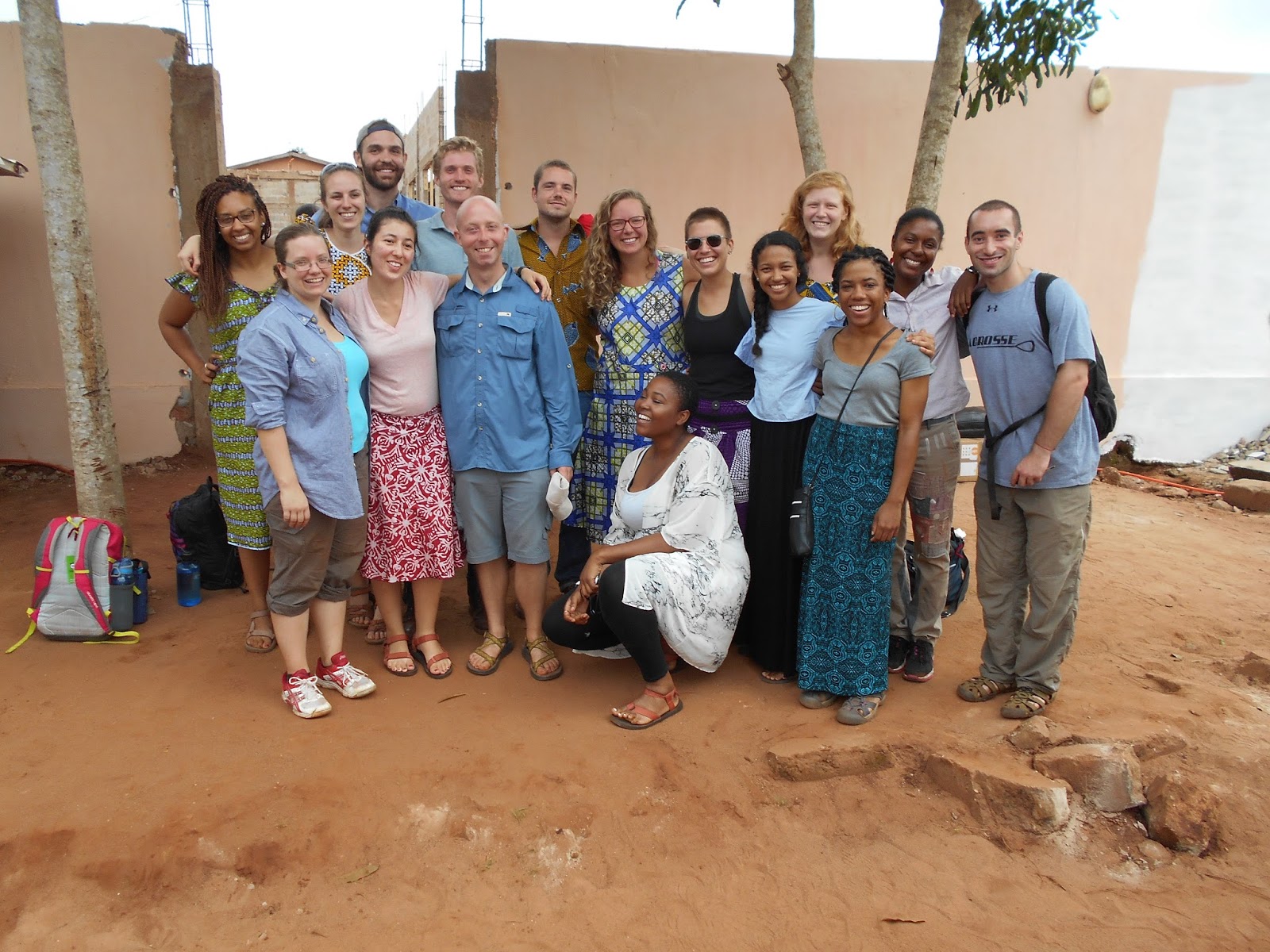
Incoming EGE Volunteers!


Saturday morning arrived in no time. The Peace Corps van picked me up from my compound at 5:30, and drove me to meet the rest of the volunteers and counterparts in the neighboring town of Aheppe. We all said our goodbyes, and piled into our assigned vans. The three vans going to the Savannes would reconvene in the town of Kante, in the Kara region, to spend the night in hotel – the journey north is not a one-day affair!

Travel in Togo has a reputation for being dirty, unpredictable, and generally the worst. We kept ourselves cool by opening the windows, but that meant I was coated in a solid quarter-inch of kicked up dirt a half-hour into the journey.

As we barreled through the Centrale region, we heard a worrisome noise from the undercarriage. We pulled over, only to discover a shot transmission. Welcome to Togo.

We volunteers walked with our counterparts about 10 minutes to a neighboring village, where a family was kind enough to lend us some shade. In exchanged, we terrified their young son with our glaringly pale skin. We waited for about 45 minutes while the other Savanes vans, a little further ahead, pulled some switcheroos, and an (air conditioned!) van turned around to retrieve us and our luggage.

Switching Luggage Around


All Crammed In

The rest of the journey, we crammed three vans worth of people into two, but the company (and the climate control) was pleasant. We rolled into Kante just after the sun went down, and spent the evening chatting with a few volunteers who came up from their villages to greet us. I even topped the night off with a running-water shower.

The next morning, everyone woke up with nerves: we piled back into the vans to finish the journey to our new homes.

Nassiete is only a few kilometers off of the main route, but there’s a world of difference in that small space. We said goodbye to the paved national route and electrical wires, and were greeted by giant, lush fields and towering flat-topped mountains. You can’t take a car to get to my compound, so I was dropped with all of my baggage on the side of the road. All of the village chiefs were there to welcome me, along with the school director, and a handful of other folks.

As is the way here in the north, we celebrated my arrival right then and there with a quick chicken-slaughtering welcome ceremony – a weird mélange of honor and horror for me. (To do: get over American sensibilities about animals, and quick.) Once the poor bird flapped its last flap, we set off on a 10 minute walk through the fields to arrive at my compound.

View From Outside the Compound

I’m living on the Bouna family compound. My host father is the president of the APE – the Association de les Parents des Eleves. He has two wives (polygamy is quite common here), and there are a total of six kids in the family, none younger than eight or so. Also on the compound are chickens, pigs, goats, cows, a donkey, ducks, a million pigeons, two dogs, and a cat. It smells a little barnyardy. I have two rooms of my own, each with cement walls, a tin roof, and a little barred window. I also have a latrine and walled-in bucket-shower zone to call my own. The water pump is about a five minute walk from the compound, but after an embarrassing display of my water-carrying ability, my host family has taken over that task for me. I’ve got some learning to do, I guess.

My Building!

Nassiete is quite large, area-wise, but only about 800 people live in the village – there’s just a lot of space for farms. There’s a primary school, and a “college” (for kids approximately 13 – 17), but for the next level, called lycee, students need to travel to the next town. We have a little boutique which is sometimes open where I can buy cookies and soap. And we have two twice-weekly “markets,” which, in actuality, sell very little, and are more just pop-up bars for the local brew, made of fermented millet and called “Tchakpalo.” And that’s the extent of that. If I want to buy phone credit or a vegetable, I need to hitch a moto ride to a neighboring village.

My Mountain


And everyone is so, so wonderful. People are friendly, helpful, welcoming, and patient with my French. They try and teach me phrases in Moba, the local language, and laugh with what I hope is glee when I can stumble through a greeting.


I’ve even been given a Moba name: Yendoube, which means "God is There." I've got a lot to live up to.